

No Sewer Required: Testing a New Generation of Sanitation Technology on Cape Cod
Published on: August 3, 2026
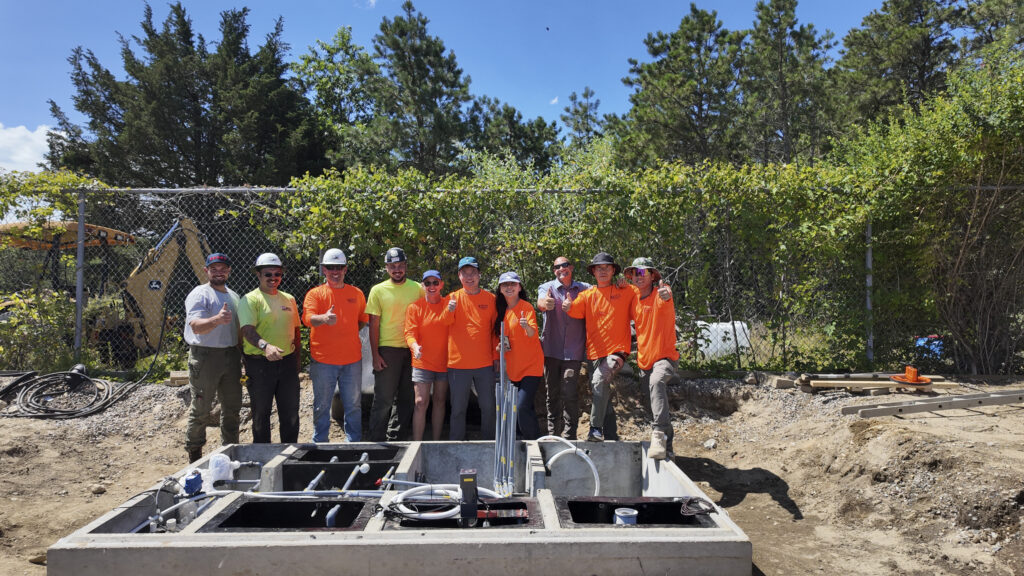
International project partners and their installation team gather at the site of a non-sewered sanitation system being installed at MASSTC.
Written by Bethany Traverse, MASSTC Certification Testing Coordinator
Wastewater Pollution on a Local and Global Scale
Wastewater is an important topic on Cape Cod, to say the least. Deteriorating watersheds, pond closures from nutrient-induced cyanobacteria blooms, sewer construction in our neighborhoods, and looming betterments impact all our communities to varying degrees.
On a global scale, the sanitation challenge is equally pressing. Mitigating the environmental impact of wastewater is secondary to the immediate public health concern of wastewater that has nowhere to go. Communities don’t have access to sewers, septic systems, or other wastewater treatment options. Clean, hygienic bathroom facilities are scarce, resulting in open defecation and the rapid spread of disease through polluted water. Waterbodies contaminated by direct inputs of raw wastewater are used for bathing and washing. According to the WHO and UNICEF, more than 3.4 billion people worldwide lack access to safely managed sanitation.
Certainly, there’s a need for innovation in wastewater management globally. An expanding population means more waste, and along with it, a growing demand to treat it safely and cost-effectively.
Developing Innovative Sanitation Solutions at Scale
Addressing a challenge of this magnitude requires a coordinated, global response. Since 2011, an ecosystem of private, public, academic and philanthropic partners, including the Gates Foundation, has invested heavily in incentivizing the research and development of innovative sanitation solutions. The result: more than 25 brand-new waste-processing technologies developed over a decade.
The next steps for these technologies are production, testing, and commercialization. If they can be marketed and sold globally, they will become more widely used and therefore more available and affordable, not only in developing countries, but also in ecologically sensitive regions like ours that seek to solve environmental degradation caused by wastewater pollution.
From Innovation to Validation
To reach this impact at scale, a premier testing facility is needed to first validate these new toilet technologies. Barnstable County’s Massachusetts Alternative Septic System Test Center (MASSTC) was identified as a prime location and partner for testing.
To meet the criteria for international and national certification standards related to these non-sewered sanitation systems (NSSS), MASSTC needed to build significant capacity. With funding from the Gates Foundation and the support of Barnstable County Commissioners and administration, MASSTC staff worked over the next year to make that happen. Now, in the summer of 2026, we’re embarking on the very first round of testing for these impactful new technologies.
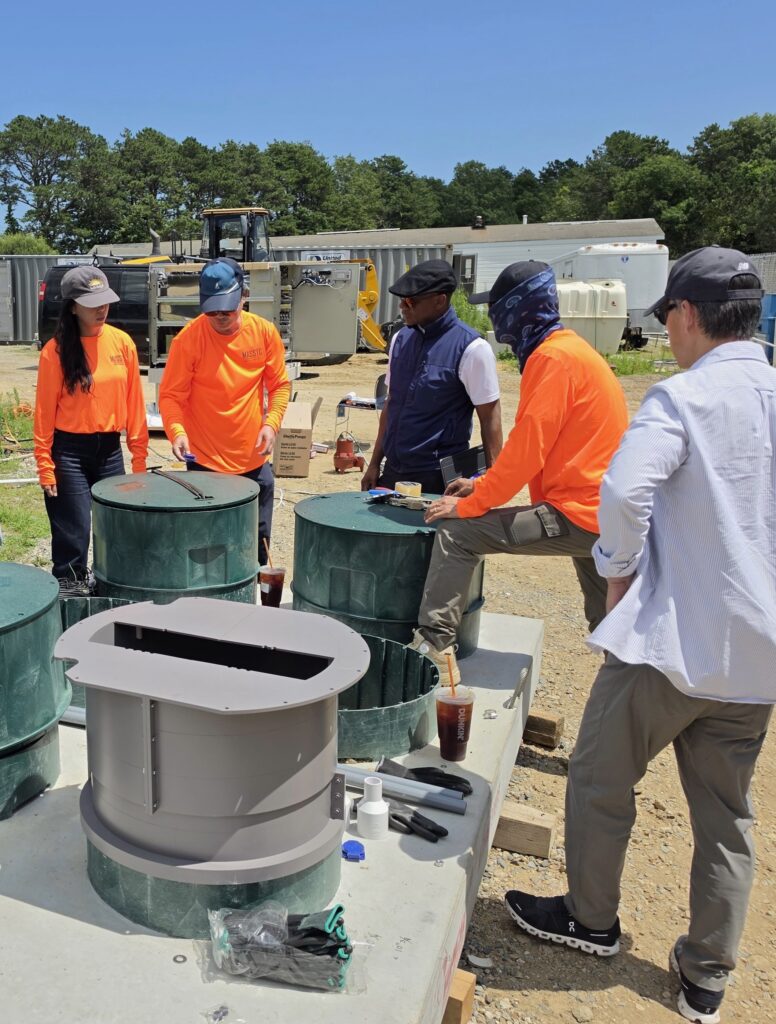
Gates Foundation representatives and international project partners review the installation of a non-sewered sanitation system—the first to undergo international and national certification testing at MASSTC. The project is supported by a Gates Foundation grant awarded in 2025.
International Collaboration
Around the start of the new year, MASSTC began communicating with two separate companies from abroad about their technologies designed to treat wastewater onsite without a sewer connection. This will be the first time these technologies have undergone testing in the United States—an important step toward bringing their systems, and other innovative technologies, to market.
After months of meetings, intense planning, an in-person overseas visit to MASSTC by international partners, method development, pursuit of laboratory accreditation, dosing design, equipment purchasing, and more, the first company is now onsite at MASSTC installing and preparing their product for international and national certification testing, which is projected to begin in August. The second company is preparing to ship their system before summer’s end.
These pioneering companies and their technologies, combined with MASSTC’s unique skill set, are making wastewater history right here on Cape Cod. The testing underway at MASSTC will help determine whether these systems can move from promising innovations to safe, certified products ready for broader use. This work represents an important step in addressing a massive global sanitation challenge.
For Cape Cod, the project also offers a glimpse into what the future of wastewater treatment could look like closer to home. Technologies designed to provide safe sanitation without sewers may eventually offer new options for environmentally sensitive communities like ours. By helping to validate these systems, MASSTC is contributing to a global effort while continuing its mission to protect water quality here on Cape Cod.
Legal Disclaimer:
EIN Presswire provides this news content "as is" without warranty of any kind. We do not accept any responsibility or liability for the accuracy, content, images, videos, licenses, completeness, legality, or reliability of the information contained in this article. If you have any complaints or copyright issues related to this article, kindly contact the author above.
