

Tech.us' Ethoric-10M Ranks #1 in 10M Category on Open SLM Leaderboard
AI consulting and AI implementation firm trains its own small language models to deepen the engineering judgment it brings to client AI projects.
SAN JOSE, CA, UNITED STATES, October 27, 2026 /EINPresswire.com/ -- Tech.us, an AI consulting, AI implementation, and AI-augmented software development company, today announced that Ethoric-10M, its latest small language model (SLM), has ranked first in the 10-million-parameter category on the Open SLM Leaderboard, as of 27th Oct 2026.
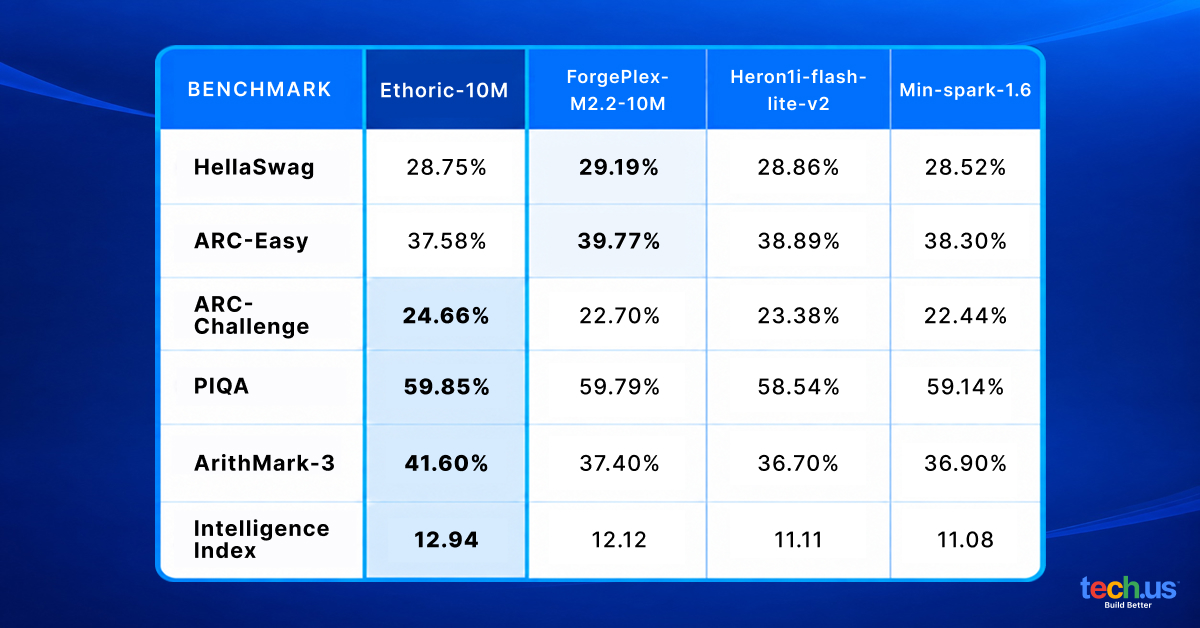
Ethoric-10M scored 41.60% on ArithMark-3, a benchmark of multiple-choice elementary math word problems designed to evaluate arithmetic reasoning. It achieved the highest score across the leaderboard's 10M and 50M categories. That score would also place fifth among the 187 models in the 100M category.
Developed by the Tech.us AI research team, Ethoric-10M investigates how architectural decisions and structured training influence the performance of small language models. Tech.us applies what it learns from building its own models to the AI consulting and implementation work it does for mid-market clients.
THE RESEARCH BEHIND ETHORIC-10M
Ethoric-10M is a 12-layer, decoder-only transformer with 9.97 million total parameters, including embedding parameters. It uses rotary position embeddings (RoPE), grouped-query attention (GQA) and SwiGLU activations.
The team added four published architectural mechanisms to that design. Each addresses a specific aspect of how information is handled inside the model.
Peri-LN supports training stability by applying RMSNorm before and after each attention and MLP sublayer. Canon layers, short causal depthwise convolutions, mix each token with its three preceding tokens before the attention and MLP sublayers.
The remaining two mechanisms focus on attention, the process that helps a language model determine which parts of its input are relevant. Per-head QK normalization rescales the queries and keys within each attention head before attention scores are computed, while headwise sigmoid gating controls how much of each head's output passes through.
A TRAINING PROCESS DESIGNED FOR FOCUSED LEARNING
Architecture was only one part of the research. The team also examined how the sequence and composition of training data could influence what a small model learns.
Ethoric-10M was trained on 19 billion tokens across two stages.
The first stage used 15 billion tokens of broad educational material to establish a foundation. This was followed by a 4-billion-token cooldown stage, during which the learning rate decreased and the training mixture shifted toward higher-quality mathematics, question-answer and tutorial-style content.
WHAT THE BENCHMARK RESULTS REVEAL
Ethoric-10M was evaluated across established benchmarks using zero-shot normalized accuracy under the Open SLM Leaderboard methodology. Beyond arithmetic, the model scored 59.85% on PIQA, 37.58% on ARC-Easy, 28.75% on HellaSwag and 24.66% on ARC-Challenge.
The HellaSwag and ARC-Challenge scores sit near the 25% random-chance baseline for these four-option tasks, which is typical at this model size.
Ethoric-10M is a research model, not a general-purpose AI assistant. It has a 512-token context window and was trained on English-language data. The model has not been instruction-tuned or safety-aligned, and its generated responses may be inaccurate or incoherent.
WHAT THE RESEARCH MEANS FOR TECH.US CLIENTS
Ethoric-10M will not be deployed in client systems. Its value to clients is the first-hand experience it gives the engineers who deliver Tech.us' AI consulting, AI implementation and AI-augmented software development work.
That experience matters as companies shift toward smaller models. According to an April 2025 Gartner prediction, organizations will use small, task-specific AI models at least three times more than general-purpose large language models by 2027. Training models from scratch gives Tech.us engineers direct practice with the decisions that determine whether those deployments succeed: when a small model can replace a large hosted one on cost, latency or data-privacy grounds, how to curate and stage training data, and how to design evaluations that hold up to scrutiny.
ETHORIC-10M BUILDS ON TECH.US' SMALL MODEL RESEARCH
Ethoric-10M follows Tech.us' earlier Tokle-3M research model, released on Hugging Face, which examined how a guided training method could influence learning in a model with fewer than 3 million parameters.
While Tokle-3M focused on introducing additional information about token relationships during training, Ethoric-10M investigates a different combination of architectural mechanisms and staged training.
AVAILABILITY
Ethoric-10M is available on Hugging Face under the MIT license. The research page covers the model's architecture, training methodology, benchmark results, and limitations.
ABOUT TECH.US
Tech.us is an AI consulting, AI implementation and AI-augmented software development company based in San Jose, California. Founded in 2000, it helps mid-market companies take AI from pilot to production and has delivered more than 1,500 projects for clients in healthcare, construction, insurance, transportation and manufacturing.
More than 100 Tech.us team members work in a hybrid U.S. and India delivery model, building HIPAA-compliant production systems. Alongside client projects, Tech.us conducts independent AI research, including its Tokle-3M and Ethoric-10M small language models.
Alex Maria Moses M
Tech.us
+1 866-277-3383
Visit us on social media:
LinkedIn
Instagram
Facebook
X
Legal Disclaimer:
EIN Presswire provides this news content "as is" without warranty of any kind. We do not accept any responsibility or liability for the accuracy, content, images, videos, licenses, completeness, legality, or reliability of the information contained in this article. If you have any complaints or copyright issues related to this article, kindly contact the author above.
