

Engineering Plastic Compounds Market Outlook 2030: Market Size, CAGR, Trends And Forecast Analysis
News originally published by
EIN Presswire
The Business Research Company
Engineering Plastic Compounds Market
The Business Research Company’s Engineering Plastic Compounds Global Market Report 2026 – Market Size, Trends, And Forecast 2026-2035
LONDON, GREATER LONDON, UNITED KINGDOM, November 26, 2026 /EINPresswire.com/ -- The engineering plastic compounds sector has witnessed notable growth recently, reflecting strong demand across multiple industries. With advancements in technology and increasing applications in emerging fields, this market is set to experience continued expansion. Let’s delve into the current market size, growth drivers, key segments, prominent trends, regional dynamics, and leading companies shaping this industry’s future.
Recent Developments and Expected Growth in the Engineering Plastic Compounds Market
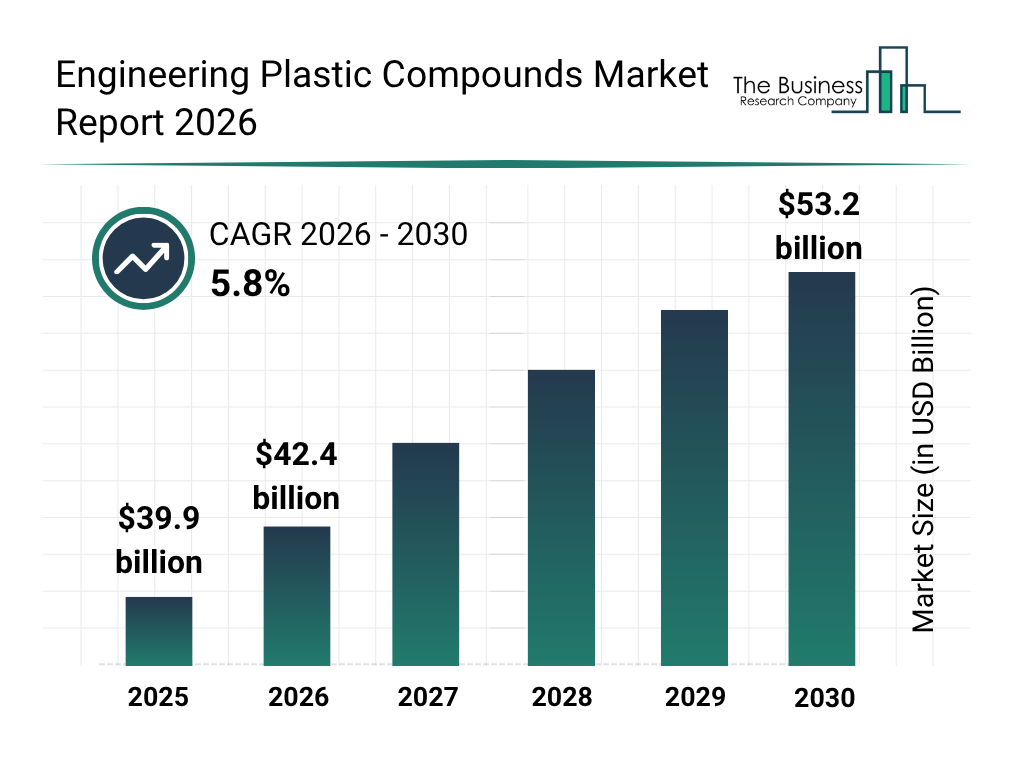
The engineering plastic compounds market has shown robust growth over recent years. Projections indicate that the market value will increase from $39.9 billion in 2025 to $42.4 billion in 2026, marking a compound annual growth rate (CAGR) of 6.3%. This upward trajectory has been supported by higher production levels in automotive manufacturing, growth in electrical and electronics sectors, expanding industrial machinery output, rising demand for durable consumer products, and advancements in medical device manufacturing.
Download a free sample of the engineering plastic compounds market report:
https://www.thebusinessresearchcompany.com/sample_request?id=80479339&type=smp&name=Engineering%20Plastic%20Compounds%20Market%20Report%202026&utm_source=EINPresswire&utm_medium=Paid&utm_campaign=Nov_PR
Looking ahead, the market is forecasted to grow further, reaching $53.2 billion by 2030, with a CAGR of 5.8%. This anticipated expansion is driven by the rising production of electric vehicles, wider adoption of cutting-edge electronics, increased need for materials capable of withstanding high temperatures, growth in aerospace components, and a shift toward lightweight materials. Noteworthy trends during this period include the development of advanced reinforced engineering plastic compounds, greater use of flame-retardant materials, demand for plastics that combine high strength with light weight, growing popularity of heat-resistant and chemically resistant compounds, along with innovations in specialized polymer blends and additive technologies.
The Influence of Electric Vehicle Growth on Engineering Plastic Compounds Demand
One of the most significant factors propelling the engineering plastic compounds market is the expanding adoption of electric vehicles (EVs). These vehicles, powered by electricity stored in batteries rather than traditional combustion engines, are gaining popularity due to their environmental benefits and energy efficiency. The shift toward sustainable transportation heightens the need for materials that are lightweight, heat-resistant, electrically insulating, and dimensionally stable.
View the full engineering plastic compounds market report:
https://www.thebusinessresearchcompany.com/report/engineering-plastic-compounds-market-report?utm_source=EINPresswire&utm_medium=Paid&utm_campaign=Nov_PR
For example, EVs require specialized plastic compounds for components such as battery housings, connectors, charging infrastructure, sensors, and thermal management systems. These materials improve vehicle efficiency, safety, durability, and weight. Supporting this trend, data from the U.S. Energy Information Administration showed that in the second quarter of 2026, electric vehicles constituted 24% of new light-duty vehicle sales in the United States, up from 22% in the same period the year before. Hybrid electric vehicles also hit a record 16% market share during that timeframe. This growing demand for EVs is a key driver behind the rising need for advanced engineering plastic compounds.
Core Segments Defining the Engineering Plastic Compounds Market
The engineering plastic compounds market is organized into several key segments, each providing insight into the market’s structure and demand channels. These include:
1) Polymer Types: This covers varieties such as Polycarbonate, Polyamide, Polymethyl Methacrylate, Polyacetal Polyoxymethylene, Polyethylene Terephthalate, Polybutylene Terephthalate, Polyphenylene Oxide, and Polyphenylene Sulfide.
2) Processing Methods: These include Extrusion, Blow Molding, Compression Molding, Rotational Molding, and Additive Manufacturing through Three Dimensional Printing.
3) Distribution Channels: The market reaches customers via Direct Sales, Distributors and Dealers, and Online Sales.
4) Applications: Use cases span Automotive Components, Electrical and Electronic Components, Industrial Machinery Parts, Consumer Goods, Medical Devices, Packaging Components, Building and Construction Materials, Aerospace Components, and other specialized areas.
Within polymer categories, there are further detailed subtypes, such as various grades of polycarbonate (e.g., Bisphenol A, high heat, optical grade), different polyamide variants, and specialized blends and reinforcements across materials like polyoxymethylene and polyphenylene sulfide, reflecting the diverse needs of multiple industries.
Sustainability and Innovations Shaping the Future of Engineering Plastic Compounds
Leading players in the engineering plastic compounds sector are increasingly focusing on sustainability by developing recycled and glass-fiber reinforced compounds. These materials not only enhance strength, stiffness, and dimensional stability but also reduce reliance on virgin plastics, supporting environmental goals and circular economy principles.
For instance, in February 2025, Japan-based Polyplastics Co., Ltd. announced plans to introduce a 40% glass-reinforced recycled DURAFIDE rG-PPS grade. This product is part of their mechanical recycling initiative, where glass-reinforced polyphenylene sulfide scrap is collected from customers, recycled, and combined with virgin materials to maintain quality standards. Such efforts contribute to waste reduction, lower carbon footprint, and improved circularity within the engineering plastics market.
Regions Leading the Expansion of the Engineering Plastic Compounds Market
In 2025, Asia-Pacific emerged as the largest regional market for engineering plastic compounds and is expected to maintain the fastest growth rate through the forecast period. The comprehensive market analysis also includes regions such as South East Asia, Western Europe, Eastern Europe, North America, South America, the Middle East, and Africa, each playing varying roles in the global market ecosystem.
Key Industry Players Influencing Market Dynamics
The competitive landscape of the engineering plastic compounds market is shaped by several prominent companies globally. These include BASF SE, SABIC, Celanese Corporation, Covestro AG, LG Chem Ltd., Toray Industries Inc., Asahi Kasei Corporation, Lotte Chemical Corporation, Envalior N.V., Mitsubishi Gas Chemical Company Inc., Kingfa Sci. & Tech. Co. Ltd., Avient Corporation, Kuraray Co. Ltd., Daicel Corporation, Teknor Apex Company, RTP Company, EMS-CHEMIE Holding AG, Ascend Performance Materials LLC, MOCOM Compounds GmbH & Co. KG, AKRO-PLASTIC GmbH, PENTAC Polymer GmbH, Syensqo SA, Evonik Industries AG, CHIMEI Corporation, DOMO Chemicals GmbH, and Radici Group S.p.A. These organizations drive innovation, sustainability, and product development within the market.
Our 2026 market reports now feature expanded strategic intelligence through market attractiveness scoring and analysis, total addressable market (TAM) analysis, company scoring matrix graphics and tables, Excel-based dashboards, market hotspots infographics, key technology and future trend analysis, along with updated graphics and tables.
Speak With Our Expert:
Saumya Sahay
Americas +1 310-496-7795
Asia +44 7882 955267 & +91 8897263534
Europe +44 7882 955267
Email: marketing@tbrc.info
The Business Research Company - www.thebusinessresearchcompany.com
Follow Us On:
• LinkedIn: https://in.linkedin.com/company/the-business-research-company
Oliver Guirdham
The Business Research Company
+44 7882 955267
info@tbrc.info
Visit us on social media:
LinkedIn
Facebook
X
Legal Disclaimer:
EIN Presswire provides this news content "as is" without warranty of any kind. We do not accept any responsibility or liability for the accuracy, content, images, videos, licenses, completeness, legality, or reliability of the information contained in this article. If you have any complaints or copyright issues related to this article, kindly contact the author above.
